

At 6:35 in the evening, on April 1, 2026, a 322-foot column of fire rose from Launch Complex 39B at the Kennedy Space Center in Cape Canaveral, Florida. With that launch, human civilization crossed a threshold it had not crossed since 1972.
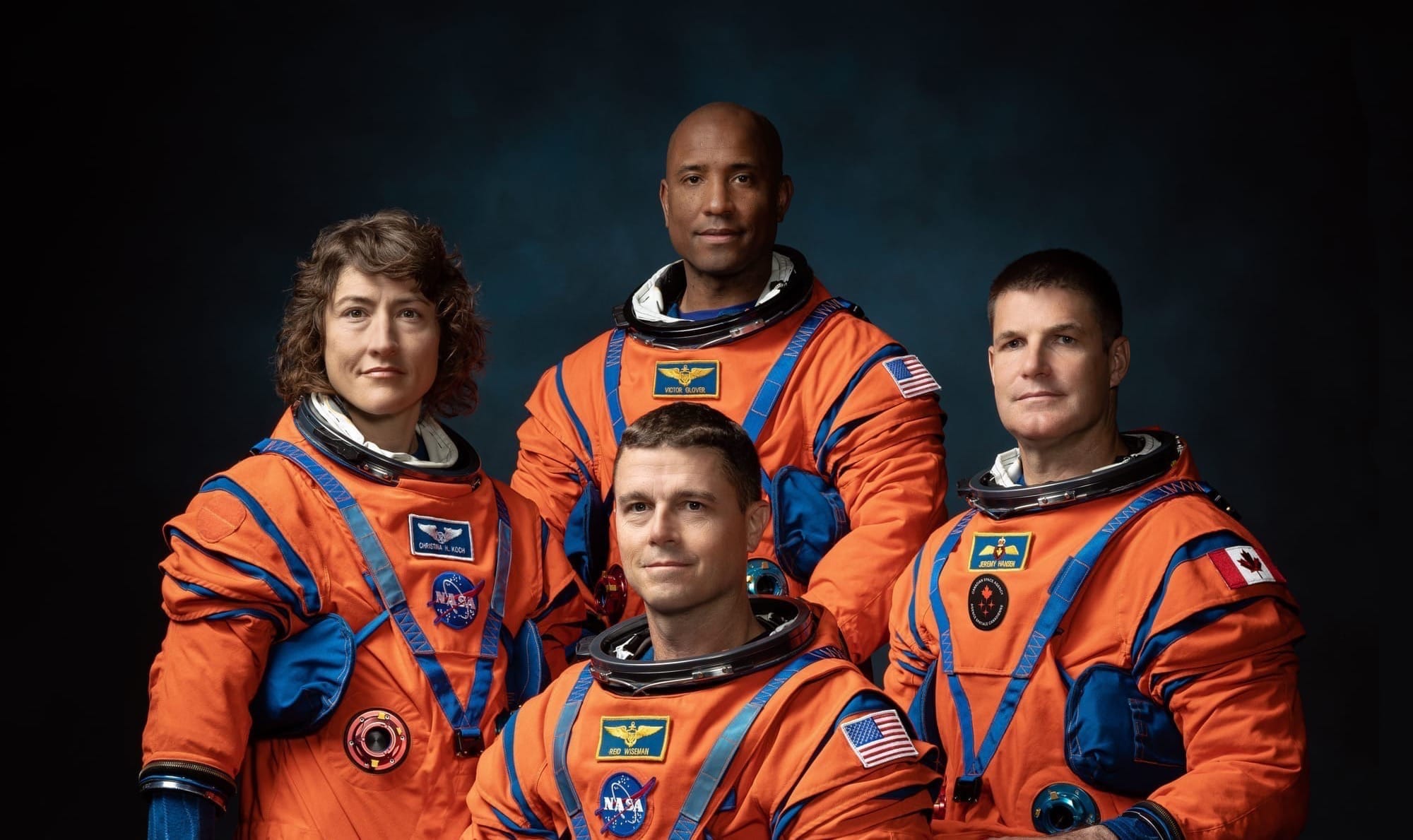
Reid Wiseman, Victor Glover, Christina Koch, and Jeremy Hansen are aboard Orion. Their hearts pound as they race toward the Moon at speeds unmatched in over fifty years. Soon, they will disappear behind it, gazing at the far side as no one has before, setting a distance record from Earth: 252,000 miles. They will return to the Pacific Ocean on April 10. After tonight, nothing in their lives—or ours—will be quite the same.
History crashes in, rarely with warning. It comes like fire—sudden, ravenous, bathing the world in stark, impossible light.
This is one of those moments.
It began, as most American ambitions do, with a dare.
On May 25, 1961, thirty-seven days after Alan Shepard became the first American in space, President John F. Kennedy appeared before a joint session of Congress and issued what remains the most daring single commitment any government has ever made to the project of human knowledge. “I believe,” he said, “that this nation should commit itself to achieving the goal, before this decade is out, of landing a man on the moon and returning him safely to the Earth.”
The room was stunned. NASA, at that moment, had twenty minutes of human spaceflight experience. The agency was barely three years old, founded in 1958 under the National Aeronautics and Space Act in response to the Soviet launch of Sputnik 1. There was no Saturn V, no Apollo capsule, no astronauts trained for a lunar landing. There was almost nothing but the dare and the belief it was worth taking.
Over the next eight years, the largest peacetime scientific mobilization took place. At its peak, NASA employed more than 400,000 people: engineers, physicists, mathematicians, machinists, seamstresses who hand-stitched spacesuit layers. The budget was 4.4 percent of federal expenditure. This was an investment in the bold proposition that humans could leave their world and survive elsewhere.
Mercury: six flights. Six Americans learned what space did to the body, the machine, the mind. Then Gemini: ten crewed missions developing Apollo’s needed skills—spacewalks, rendezvous, reentry. Then Apollo: the answer to Kennedy’s dare.
Apollo 1 nearly ended it before it began. On January 27, 1967, a fire ran through the command module during a launch rehearsal, killing Gus Grissom, Ed White, and Roger Chaffee. The agency grieved. The agency rebuilt. That is what NASA has always done.
Apollo 7 flew in October 1968. Apollo 8 circled the Moon that December, and its crew read from Genesis as they looked down at a world none of them fully recognized anymore. Apollo 9 and 10 tested and refined. Then, on July 20, 1969, Neil Armstrong stepped off the ladder of Eagle and onto the surface of the Sea of Tranquility. Six hundred million people watched. The dare had been answered.
What followed was nothing short of miraculous—and then it was gone. Apollo 11 through 17: twelve humans walked on the Moon, gathered precious stones, and forever changed our understanding of our cosmic home. Apollo 13 stared down disaster and survived through sheer ingenuity and courage. Apollo 17, December 1972: Cernan and Schmitt in Taurus-Littrow. Cernan’s farewell—’We leave as we came, and, God willing, as we shall return.’ The words hung in the silence, echoing a promise across the lifeless lunar dust.
Fifty-four years passed before anyone tried to return humans to the Moon.
But the science did not stop. Automated missions continued. Probes mapped Mars, landed on comets, and flew past Pluto. They detected signs of planets orbiting faraway stars. The International Space Station orbited for twenty-five years as a human outpost in low Earth orbit. It became a monument to international cooperation and quiet scientific work. The Hubble Space Telescope reframed our insight into the universe’s age and scale. The James Webb Space Telescope went even further.
But the Moon—Kennedy’s target, Armstrong’s step, Cernan’s farewell—remained unvisited by humans for over five decades.
The reason is not a secret, and it is not flattering. After Apollo, Congress methodically starved deep-space human exploration. NASA’s budget, once soaring to near 4.5 percent of federal spending, was slashed to below 1 percent and left to wither. The money vanished. It led to two catastrophic wars in the Middle East. By even the most cautious counts, these wars bled over $8 trillion and delivered a bitterly small return on their extravagant promises. Money cascaded into tax structures that propped up the wealthy, while the nation’s infrastructure withered and cracked. It also bolstered a military apparatus capable of annihilating the world many times over. As if once wasn’t devastation enough.
This is the accounting error history that will not be forgiven. Federal budgets are choices: how resources shape the future and define our purpose.
The full cost of the Artemis initiative is about $93 billion through the first missions. That is real money. It is also about one-eleventh of what the United States spent on the wars in Iraq and Afghanistan. One-eleventh. For the Moon. For science. For humanity’s most fundamental question: can we survive out there, beyond the thin blue membrane that has always protected us?
The question has become urgent. Not abstractly urgent. Urgently urgent. The climate of this planet is unraveling—storm by storm, record by shattered record—at a speed that no serious scientist disputes. The Artemis initiative is not, at its core, a romantic enterprise. It is reconnaissance. The Moon is a staging ground. Mars is the destination. Mars is the contingency plan. For decades, our civilization has treated its only home not as an inheritance to cherish, but as a resource to be consumed.
Victor Glover will become the first person of color to leave low Earth orbit. Christina Koch will be the first woman to do so. Jeremy Hansen will be the first non-U.S. citizen to travel beyond low Earth orbit and to the Moon’s vicinity. This is the visible shape of a program that has, though imperfectly and haltingly, tried to extend the promise of exploration to the full breadth of the civilization it represents.
NASA’s first female launch director, Charlie Blackwell-Thompson, sent them off with words that fit the moment precisely: “Reid, Victor, Christina and Jeremy, on this historic mission you take with you the heart of this Artemis team, the daring spirit of the American people and our partners across the globe, and the hopes and dreams of a new generation.”
Hopes and dreams sound sentimental—almost childish—until you remember the alternative: a world that has forgotten how to hope, cringes inward, cowers before the unknown. One that abandons the stars, shrinks with fear, and looks for enemies in every mirror. That world withers. That world cannot endure.
The Apollo generation—engineers, scientists, machinists, seamstresses—built something that outlasted the Cold War. They proved that organized, funded, and trusted people could solve problems no individual, corporation, or market could solve alone. They developed GPS, scratch-resistant lens materials, memory foam, and water filtration systems, now used in developing countries. They built the computing frameworks behind the digital revolution. Every NASA dollar spent in the 1960s has, by various estimates, returned seven to fourteen dollars to the wider economy.
This is the argument for science. Not the romantic argument, though that stands on its own. The economic argument. The civilizational argument. The most practical thing a society can do is invest in expanding what is known, because knowledge compounds. It does not depreciate. It does not rust. It does not come home broken.
The moon hasn't changed. We have. And this month, for the first time in 54 years, four human beings left the Earth to prove it.
The crew will spend their first twenty-four hours after launch in an elliptical orbit around the Earth. Then, a critical engine firing called the trans-lunar injection will boost the ship’s velocity by about 900 miles per hour. This pushes it out of Earth orbit, beginning the four-day coast to the Moon. The spacecraft will use lunar gravity to bend its path back toward Earth. They will return for splashdown in the Pacific Ocean on April 10.
It is called a free-return trajectory. The Moon’s gravity becomes the instrument of return. It is elegant in the way that the best engineering is elegant—not flashy, not wasteful, but precisely fitted to the problem.
Artemis II is intended as a test flight. It is designed to check out systems and equipment and lay the basis for future missions to land astronauts on the moon in 2028. This is the rehearsal for the landing. It is the moment before the moment. Yet it is historic in the same way Apollo 8 was. Not the first footprint, but the first time human eyes saw the lunar farside in person. The first time, the perspective changed. The first time the Earth appeared small.
Gene Cernan left his daughter’s initials in the moon dust in December 1972. Teresa Dawn Cernan. TDC. He said he hoped someone would come back someday and find them. The Moon has no wind. No weather. The initials are still there.
Tonight, four human beings streak through the silence, chasing those letters in the lunar dust. Hope, longing, memory—and tonight, at last, return.
The question Kennedy asked in 1961 was not really about the Moon. It concerned the kind of civilization America intended to be, and how it would face its future. The Moon was the test.
We passed it. Then we turned away. Then we turned back.
Tonight, at 6:35 in the evening, from a launch pad that has held American rockets since the Apollo era, fire answered the question again. The same answer. The only answer this civilization has ever given was when it was at its best.
We go.
Not because it is easy. Because it is necessary. Because the alternative—a species that looked up, reached out, and then chose to look away—is not a species that deserves the stars it can see from its front porch on a clear night.
The Moon is there. It has always been there. And as of tonight, April 1, 2026, the human race has remembered, once again, that it does not intend to stay home.
Artemis II. Four astronauts. Ten days. 252,000 miles.
The farthest any human being has ever traveled from Earth.
This is what we look like when we are trying.
Reid Wiseman: Commander | Victor Glover: Pilot | Christina Koch: Mission Specialist | Jeremy Hansen: Mission Specialist (CSA)
Launched 6:35 p.m. EDT, April 1, 2026. Kennedy Space Center, Launch Complex 39B.
Expected splashdown: April 10, 2026. Pacific Ocean.
